Failure Mode · FM-05 · Deerwood · 32256
Sub-Zero Frost Buildup & Defrost Failure on the Deerwood Southside
A Sub-Zero that ices over behind the freezer panel — warm refrigerator, still-cold freezer — is almost never a door left ajar. It is the automatic defrost cycle failing, and on Deerwood's mixed built-in stock it is one of the cheaper repairs we run.
When a Sub-Zero® evaporator frosts over and the refrigerator warms while the freezer stays cold, the cause is a failed defrost heater, defrost thermostat, or defrost control — $250–$1,100 — not a dead compressor or a leak. Manual defrosting only buys days. We diagnose the defrost cycle with a meter, weekdays 07:00–19:00; reach (904) 893-3248.
For Sub-Zero repair across Deerwood and the Jacksonville Southside, call (904) 893-3248 or book online.
Updated June 13, 2026
At a glance: a frosted coil in 32256
Three answers before dispatch. Sub-Zero Repair Deerwood covers Deerwood Country Club and the wider Southside corridor — Pablo Creek Reserve, Glen Kernan, and Queen's Harbour in ZIPs 32256, 32224, and 32225. Direct line (904) 893-3248, with an external online booking page and gate details logged at booking.
What actually causes the frost?
A built-in Sub-Zero defrosts itself automatically on a timed cycle: a heater briefly warms the evaporator coil to melt the frost that normal use deposits, and a defrost thermostat ends the cycle once the coil is clear. When the heater, the thermostat, or the control that triggers them fails, the coil never gets cleared. Frost grows into a solid ice sheet, the evaporator fan can no longer move air through it, and the refrigerator starves for cold air.
Why is the freezer still cold?
Because the evaporator coil lives inside the freezer compartment. Even buried in ice, the coil is still cold, so the freezer — sitting right on it — keeps holding temperature. The refrigerator, which depends on the fan pushing that cold air upward, is the section that warms. That warm-fridge-cold-freezer split is the single most useful clue you can give us.
Is this expensive?
Usually no. Defrost components are among the least costly repairs on a built-in, $250–$1,100 depending on the part and the model. The fear is always a sealed-system leak or a failed compressor; the frost-and-warm-fridge pattern points away from both.
Cause, evidence, and cost lane
| Cause | Evidence on inspection | Cost lane |
|---|---|---|
| Defrost heater open / failed | Hard ice sheet on coil, heater fails continuity test | $250–$700 |
| Defrost thermostat stuck open | Coil iced, thermostat won't close at cold temperature | $250–$550 |
| Defrost control / board section dead | Heater and thermostat test good, cycle never triggers | $550–$1,100 |
| Surge-damaged board after a storm | Defrost dead alongside other functions, recent outage | $550–$1,100 |
| Door / gasket frost (not a defrost fault) | Soft frost at the seal, clears once the door stays shut | $250–$550 |
If the cabinet is warming with no visible frost, it may not be defrost at all — the not-cooling triage walks the fan, thermistor, and board causes; if the display is dark, start with the blank-panel procedure; and if a code is logging, the EC50 and EC40 reference covers the excessive-run warnings.
How automatic defrost works — and how it fails
Every frost-free built-in deposits a little frost on its evaporator coil during normal running — moisture from the air condenses and freezes on the coldest surface in the cabinet. To stop that frost from accumulating, the unit runs a defrost cycle on a timer: it cuts cooling for a few minutes, energizes a defrost heater that warms the coil just enough to melt the frost, and the meltwater drains away. A defrost thermostat watches the coil and ends the cycle the moment it warms past freezing, so the heater never overheats anything. Then cooling resumes.
The failure is simple to picture. If the heater burns open, the cycle runs but melts nothing. If the thermostat sticks open, the heater is never allowed to energize. If the control or the board section that schedules the cycle dies — a real risk after a Northeast Florida restoration surge — the cycle never starts. In all three cases the outcome is identical: each cooling run adds frost, none gets removed, and within days to weeks the coil is a solid block of ice. The evaporator fan whirs against a wall of frost, the refrigerator loses its air supply and warms, and the freezer — sitting on the still-cold coil — keeps holding. The picture below shows where that coil lives, behind the freezer back panel, which is why owners almost never see the ice forming.
Community-specific access and equipment notes live on the Deerwood Country Club coverage page, and the warm-cabinet-but-no-frost variant is covered on the not-cooling page.
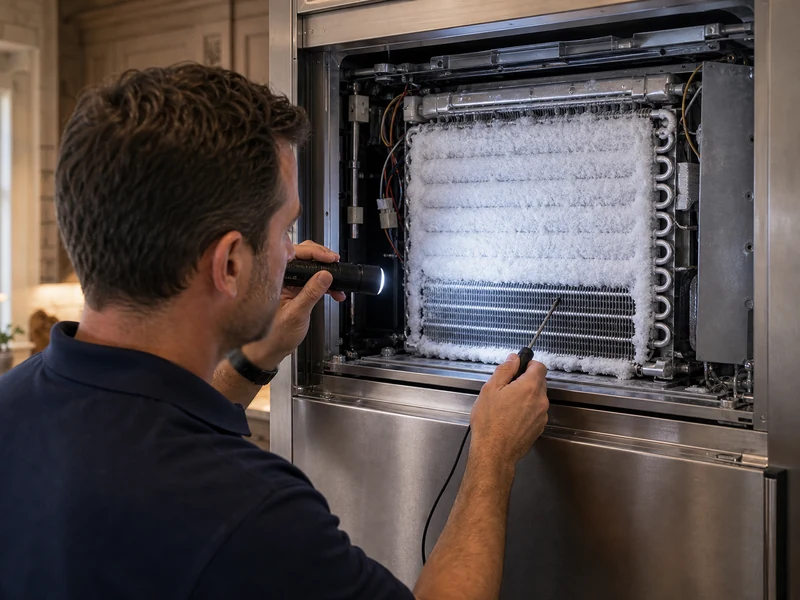
Defrost system reference
- Defrost heater
- Element that briefly warms the evaporator coil to melt accumulated frost. Burns open with age; fails the coil clear, so ice builds. $250–$700 typical.
- Defrost thermostat
- Temperature switch that closes to allow the heater to run and opens to end the cycle. Stuck open means the heater never energizes. $250–$550 typical.
- Defrost control / board section
- Times and triggers the defrost cycle. On built-ins this is part of the control board, vulnerable to restoration surges after a lightning outage. $550–$1,100 typical.
- The warm-fridge tell
- Refrigerator warm, freezer still cold, hard ice on the coil behind the freezer back panel — the defrost signature, distinct from soft door-seal frost that clears on its own.
- Set points
- 38°F refrigerator / 0°F freezer; a built-in needs 24 hours to stabilize after the defrost cycle is restored.
One honesty note specific to Deerwood's range of equipment: a unit from the 2022-and-later CL or DET generation is usually still under factory warranty, and those belong with Factory Certified Service first. We take the out-of-warranty work, the second opinions, and the maintenance that warranty never covered.
The diagnostic sequence — cheapest cause first
A frosted-coil call runs a metered order built to clear the cheap, common causes before touching anything refrigerant. The frost pattern is the first and most decisive read.
- Confirm the split. Verify the refrigerator is warm while the freezer holds. That split alone points at the defrost system and away from the sealed system or compressor before any panel comes off.
- Rule out the door and gasket. Soft frost at the seal that clears once the door stays shut is an airflow problem, not a defrost fault — the cheapest possible finding. We check the gasket seal and door alignment first.
- Pull the freezer back panel and read the coil. A hard, even ice sheet on the evaporator confirms a failed defrost cycle. Frost on only the first few inches of the coil would point instead at the sealed system — a different and rarer diagnosis.
- Meter the heater and thermostat. Heater continuity and the thermostat's behavior at coil temperature separate a $250–$700 part from a board-level repair. This is where most frosted-coil calls resolve.
- Check the control and surge history. If the heater and thermostat test good, the defrost trigger on the board is the suspect — and a recent outage often confirms it, routing to the control-board procedure.
Why manual defrosting is only a temporary fix
It is tempting to unplug the unit, let the coil thaw overnight, and call it solved when the refrigerator cools again. It does cool again — for a few days. But thawing the ice does nothing to the failed heater, thermostat, or control that let the ice form. The defrost cycle is still dead, so each cooling run rebuilds the frost, and within days to a couple of weeks the coil is blocked again and the fridge is warm again.
Manual defrosting is genuinely useful for exactly one thing: it confirms the diagnosis. A unit that recovers full cooling after a thaw, then degrades again on a predictable clock, has told you precisely what is wrong — the defrost system. The real repair is replacing the failed component so the cycle clears the coil on its own, the way it is designed to, every cooling run for the next decade. Repeated hand-thawing also risks water in places it should not be and a meltwater drain that ices up in turn. We restore the cycle once rather than ask an owner to babysit a coil.
Diagnostic case notes from Deerwood
Educational diagnostic scenarios, not customer reviews.
Deerwood Country Club, BI over-under. Refrigerator drifting into the mid-40s°F, freezer holding 0°F, owner had already wiped the gasket with no change. The freezer back panel came off to a solid ice sheet on the evaporator. The defrost heater failed continuity — an open element. With the heater replaced and the coil cleared, cooling returned and held through the 24-hour stabilization check. An electrical repair, not a sealed-system one.
Deerwood, built-in column. Owner reported the fridge warmed within days of an afternoon storm and brief outage. The coil was iced, but unlike the heater case the defrost components themselves metered good — the board section that triggers the cycle had been knocked out by the restoration surge, consistent with the corridor's lightning load. Board service restored the defrost cycle, and a point-of-use surge device was recommended so the next storm season would not repeat the failure.
Frost and defrost questions from Deerwood owners
- Why is my Sub-Zero refrigerator warm while the freezer is still cold?
- That specific split — warm fridge, cold freezer — is the classic signature of a defrost-system failure on a built-in Sub-Zero. The evaporator coil sits in the freezer compartment and feeds cold air to both sections through a fan. When the automatic defrost cycle stops clearing the coil, frost grows into a solid sheet that the fan can no longer push air through. The freezer, sitting right on the iced coil, stays cold; the refrigerator, which depends on that blocked airflow, gradually warms. It is rarely a refrigerant problem and rarely a compressor problem, which is why it lands in a far cheaper repair lane than most owners fear.
- How is a real defrost failure different from frost because a door was left ajar?
- Pattern and recovery. A door left open or a tired gasket lets humid Jacksonville air in, so you see soft, fluffy frost near the seal, on the front edges, and on packages — and it clears on its own once the door stays shut. A defrost-system failure builds hard, clear ice on the evaporator coil behind the freezer back panel, where you cannot normally see it, and it never clears no matter how carefully you close the door. If wiping the gasket and keeping the door shut for a day fixes the warming, it was airflow at the door. If the fridge keeps warming, the coil is iced and the defrost cycle has failed.
- Which defrost part usually fails — heater, thermostat, or control?
- On the built-in installed base around Deerwood, the defrost heater and the defrost thermostat are the two most common, and they fail in similar ways: the coil never gets cleared, so it ices over. The defrost control or the board section that triggers the cycle is the third suspect, and a surge-damaged board can knock out the defrost cycle the same way it knocks out other functions after a lightning outage. A technician separates them with a meter — checking heater continuity, the thermostat at temperature, and the board outputs — rather than swapping parts on a guess. All three sit in roughly the same cost range, so the diagnosis matters more for time than for price.
- Why is manually defrosting it only a temporary fix?
- Because melting the ice treats the symptom, not the cause. If you unplug the unit and let the coil thaw — or aim a hair dryer at it — the airflow comes back and the refrigerator cools again for a few days. But the defrost cycle is still dead, so the coil simply re-ices and you are back to a warm fridge within days to a couple of weeks. Manual defrosting is useful for one thing only: it confirms the diagnosis. If cooling returns after a thaw and then degrades again on a predictable clock, the defrost system is the culprit and the actual repair is replacing the failed component.
- Does Jacksonville humidity make Sub-Zero frost problems worse?
- It accelerates them. Northeast Florida runs high humidity year-round, so every door opening pulls more moisture into the cabinet than a drier climate would. A healthy defrost cycle handles that load fine. But once the defrost heater or thermostat fails, the same humidity that a working system shrugs off now feeds a faster, thicker ice sheet on the coil — which is why Deerwood owners often notice the warming come on quickly rather than over months. The humidity does not cause the defrost failure; it makes the consequences show up sooner and look more dramatic.
- Is a defrost repair worth it on an older Deerwood Sub-Zero?
- Almost always. The defrost heater, thermostat, and control are among the least expensive repairs on a built-in — they fall in the $250–$1,100 range depending on which part and which model — while the cabinet itself is a five-figure replacement once you count integration and panels. Deerwood kitchens hold a wide span of equipment, from 1990s remodels to recent column installs, but the defrost system is a defined wear item across all of them. Unless the unit has a separate, genuine sealed-system fault, restoring the defrost cycle returns a built-in to full service for a small fraction of replacement cost.
- How long does a defrost repair take, and will my food survive?
- The repair itself is typically a single visit once the failed part is identified and on the van, though access varies by model because the coil lives behind the freezer back panel. For your food: a built-in with the doors kept shut holds cold for several hours, and with a defrost failure the freezer side usually stays cold longest because it sits on the coil. Watch a thermometer in the refrigerator section — perishables reach the 40°F discard line there first. With same-day diagnosis on a corridor address minutes from Southside Boulevard, most frosted-coil units are caught well inside the safe window.
Service pages
Put a Southside Sub-Zero specialist on the schedule.